
Salaam from Al-Huda Network your trusted UK-based online Quran academy.
You sit in your neighbourhood mosque after Jummah. The imam mentions Al-Quds, and something stirs inside. That pull is ancient. It started long before any of us were born, with a command from Allah Himself.
Surah Al-Isra opens with clear words: “Glory be to the One Who took His servant by night from the Sacred Mosque to the Farthest Mosque, whose surroundings We have blessed, to show him of Our signs. Indeed, He is the All-Hearing, the All-Seeing.” (17:1)
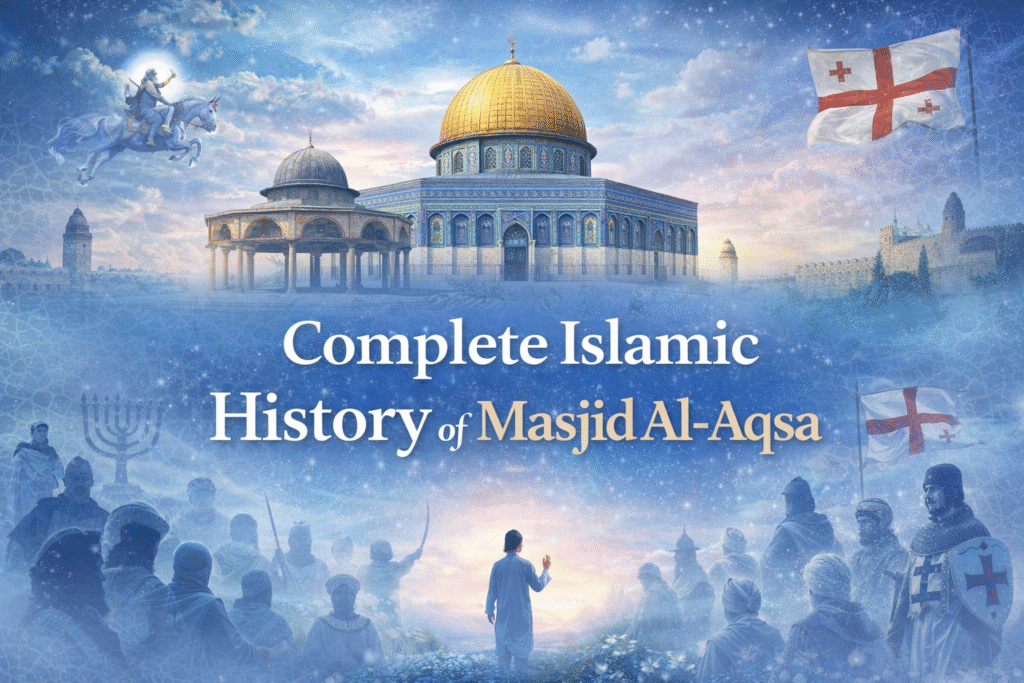
This verse names the site we call Masjid Al-Aqsa — or Bait al-Maqdis, the blessed land of Sham. The whole 35-acre plateau counts as the mosque, not just the silver-domed prayer hall. The golden Dome of the Rock sits at its heart. Together they form the third-holiest sanctuary after Makkah and Madinah.
Muslims everywhere feel this bond. All over the world, imams at different Mosques regularly remind crowds of the first Qibla. Families gather for Al-Quds Day rallies in streets waving flags and raising slogans that echo across generations. These gatherings turn abstract history into living faith.
The Quranic Mention and Blessed Status of Masjid Al-Aqsa
Allah calls the land around Al-Aqsa “blessed.” Scholars explain this barakah touches crops, souls, and prophets alike. Surah Al-Rum (30:2-4) hints at future victories in the region, tying the place to divine promise.
The entire Haram al-Sharif carries this blessing. Angels once descended here. Prophets walked its stones. Even today, the call to prayer rises from its minarets, carrying the same words you hear back home.
Masjid Al-Aqsa in the Era of the Prophets (Peace Be Upon Them)
Prophet Adam (peace be upon him) laid the first stones.
A sound hadith reports Abu Dharr asking the Messenger ﷺ which mosque came first on earth. The reply: “Al-Masjid al-Haram.” Then which? “Al-Masjid al-Aqsa.” How long between them? “Forty years.” (Bukhari)
Some narrations add that after finishing the Kaaba, Adam received command to travel north and establish worship here. That makes Al-Aqsa the second house of Allah on earth.
Later, Prophet Ibrahim (peace be upon him) migrated to the area. He rebuilt the sanctuary, taught tawheed, and passed custodianship to his descendants. His grave lies nearby in Al-Khalil — a short drive from the compound today.
Prophet Dawud (peace be upon him) conquered the city from idol-worshippers. He meditated in a private chamber within the sanctuary. His voice reciting the Psalms made the surrounding hills echo.
His son, Prophet Sulaiman (peace be upon him), completed the grand structure. Winds carried him across the land as he oversaw the work. Before finishing, he made a beautiful dua: “O Allah, grant me a kingdom no one after me will have, and cause no one to come to this mosque intending only to pray except that he leaves forgiven like the day his mother bore him.” (Ibn Majah, graded hasan)
Other prophets worshipped here too — Zakariyyah served as imam, Maryam received angelic news, and Isa (peace be upon them all) prayed within its walls. Ibn Abbas reported: “Not a single hand-span of Bait al-Maqdis exists without a prophet having prayed there or an angel having stood upon it.” (Tirmidhi)
The Night Journey (Isra) and Ascension (Mi’raj) – The Defining Islamic Event
The Prophet ﷺ faced the Year of Sorrow — loss of Khadijah and Abu Talib, rejection in Taif. Then came the miracle.
One night, while resting near the Kaaba, Jibril opened his chest, washed it with Zamzam, and filled it with wisdom. A white steed named Buraq appeared — larger than a donkey, smaller than a mule.
They stopped at key places en route: the future site of Hijrah in Madinah, Mount Sinai where Musa received the Torah, Bethlehem where Isa was born, and finally the grave of Musa where the Prophet saw him standing and praying inside his tomb.
Upon reaching Jerusalem, Jibril tied Buraq to the western wall with a crack still visible today. Inside the sanctuary waited 124,000 prophets. The Prophet ﷺ led them all in prayer — the only time every messenger gathered behind one imam.
After two rak’ahs of tahiyyat al-masjid, they moved to the Noble Rock. From there the Mi’raj began. Five daily prayers were prescribed, reduced from fifty at Musa’s wise advice. The Prophet returned the same night, describing details of the distant mosque so precisely that doubters fell silent.
This journey turned hardship into hope. It reminds every believer facing trials that relief follows difficulty — a message we repeat when discussing current struggles in Palestine.
Masjid Al-Aqsa as the First Qibla of Islam
For sixteen or seventeen months after Hijrah, Muslims faced Jerusalem in prayer. The change to Makkah came in Surah Al-Baqarah (2:142-144). The shift tested faith but never erased the honour of the original direction.
Even after the switch, the Prophet ﷺ continued to honour the site. He told companions: “You should not set out on a journey except to three mosques: the Sacred Mosque, this mosque of mine, and Masjid Al-Aqsa.” (Bukhari & Muslim)
Construction and Flourishing Under the Rightly-Guided and Successor Caliphs
In 637 CE, Caliph Umar ibn al-Khattab accepted Jerusalem’s peaceful surrender from Patriarch Sophronius. He found the Rock covered in rubbish — Christians had used it as a dump to spite Jews.
Umar rolled up his sleeves and began clearing it himself. Companions joined until the area was clean. He built a simple wooden prayer hall at the southern end — the first Muslim structure on the site.
Later caliphs expanded it. Abd al-Malik (Umayyad) started major work around 690 CE, completing the Dome of the Rock in 691-692. His son al-Walid I finished the main Qibli Mosque between 705-715. Earthquakes damaged it over time — Abbasids and Fatimids repaired it, adding beautiful mosaics and the famous inscription linking back to the Isra event.
Here is a clear timeline:
| Period | Key Event | Main Figure(s) | Lasting Impact |
| ~40 years after Kaaba | Foundation laid | Prophet Adam (AS) | Second house of worship on earth |
| ~1000 BCE | Major rebuilding completed | Prophets Dawud & Sulaiman (AS) | Royal structure and kingdom centre |
| 637 CE | Peaceful conquest & cleaning | Caliph Umar (RA) | First Muslim prayer hall |
| 690-715 CE | Dome of the Rock & Qibli Mosque built | Abd al-Malik & al-Walid I | Enduring Islamic landmarks |
| 746-1065 CE | Restorations after earthquakes | Abbasid & Fatimid caliphs | Expanded aisles, mosaics, inscriptions |
| 1099-1187 CE | Crusader occupation & liberation | Salahuddin Ayyubi | Return to Muslim rule |
| 1517-1917 CE | Ottoman maintenance | Ottoman sultans | Consistent care and open access |
| 1967-present | Modern custodianship challenges | Hashemite Waqf & global Ummah | Ongoing stewardship and awareness |
Virtues, Rewards, and Hadiths of Masjid Al-Aqsa
Authentic reports highlight huge rewards.
Abu Darda (RA) narrated: “A prayer in Makkah equals 100,000 prayers, in Madinah 1,000, and in Al-Aqsa 500 — all compared to anywhere else.” (Tabarani, graded hasan)
The Prophet ﷺ said: “Whoever comes to this mosque (Al-Aqsa) intending only to pray, he leaves free of sin like the day his mother bore him.” (From Sulaiman’s dua, accepted by Allah)
Another hadith: “One prayer in Al-Aqsa equals 1,000 prayers elsewhere, except in the two Sacred Mosques.” Variations appear in reliable collections.
If travel is impossible, send oil for its lamps. The Prophet ﷺ said the one who does so receives reward as if he prayed there himself.
Practical insight: Set a reminder on your phone for 27 Rajab each year. Even a small donation for maintenance multiplies like ongoing charity. Different organisations regularly collect for lamp oil and carpet repairs — your contribution joins thousands of others.
Architectural Evolution and Spiritual Features of the Compound
The Qibli Mosque stretches 83 metres long and 56 metres wide. Its lead-covered dome reflects sunlight softly. Inside, 53 marble columns and 49 rock columns support the roof. Mosaics from Fatimid times still shine.
The Dome of the Rock, octagonal and golden, covers the Noble Rock from which the Mi’raj began. Its interior tiles and inscriptions date to the 7th century — some of the oldest Islamic calligraphy anywhere.
Forty-two smaller structures, gates, and minarets fill the plateau. Each corner holds spiritual weight. Standing at the western wall where Buraq was tied, or praying near the Rock, connects you directly to the Night Journey.
Resilience Through History – Crusades, Ottoman Era, and Contemporary Significance
Crusaders captured Jerusalem in 1099 and turned the Qibli Mosque into a palace and stable. They defiled the Rock. For 88 years Muslims longed for its return.
In 1187, Salahuddin Ayyubi entered after the Battle of Hattin. He cleaned the sanctuary, restored the mihrab, and opened it for worship again. His chivalry — allowing Christians safe passage — became legendary even among opponents.
Ottoman rule from 1517 brought stability. Sultans repaired domes, added fountains, and kept the site open to all faiths while preserving Muslim custodianship.
After 1967, the Hashemite Kingdom of Jordan retained administrative responsibility through the Waqf. Challenges continue, yet Friday prayers still draw thousands. The site remains a symbol of unity for 1.8 billion Muslims.
How Muslims Can Honor and Support Masjid Al-Aqsa Today
Start with dua. After every salah, say: “Allahumma barik lana fi Sham wa barik lana fi Misr…” and specifically ask for protection of Al-Aqsa.
Teach your children. In homes, show maps during family time. Link it to stories of Umar and Salahuddin.
Raise awareness. Share verified updates. Attend or organise local events like the annual Al-Quds Day rallies held across the world in cities.
Support practically. Donate to trusted organisations that fund maintenance, olive-tree planting around the area, or aid for families living near the compound. Even small monthly sadaqah counts as ongoing charity.
Boycott products that fund occupation — a step many families already take after Friday sermons.
If you ever visit, perform two rak’ahs upon entering and send greetings to the prophets who prayed there before you.
Conclusion
Masjid Al-Aqsa is not just stones and domes. It is a living thread connecting every Muslim to Adam, Ibrahim, Muhammad ﷺ, and the promise of divine blessing.
Its history teaches patience, unity, and active care. Muslims have shown that spirit through decades of awareness and support. Keep that flame bright — in your prayers, your conversations, and your actions.
The land remains blessed. Its story continues through us.
At Al-Huda Network, we have helped hundreds of UK families, converts, and children truly understand and love the Quran through live, one-to-one classes with qualified tutors at times that suit British schedules.
Frequently Asked Questions
Who built Masjid Al-Aqsa first according to Islamic sources?
Prophet Adam (peace be upon him) laid the foundation forty years after the Kaaba, with later rebuilding by Ibrahim and completion by Sulaiman (peace be upon them).
What is the reward for praying in Masjid Al-Aqsa?
Reports state it equals five hundred prayers elsewhere, with special forgiveness for those who travel with pure intention.
Is Masjid Al-Aqsa the same as the Dome of the Rock?
No. The Dome covers the Rock of Mi’raj; the Qibli Mosque is the main prayer hall to its south. The whole compound is Al-Aqsa.
Why was it the first Qibla?
Allah chose it to unite earlier prophetic traditions before directing the final Qibla to Makkah.
Can I support Al-Aqsa without travelling there?
Yes through dua, education, donations for maintenance, and raising awareness at local events in uk..