
Introduction: Why Tafsir Matters
The Qur’an is divine revelation intended to guide humanity in belief, law, and moral conduct. While recitation remains an act of worship, proper engagement with the Qur’an requires understanding its meanings as revealed and explained through authoritative sources.
Translations offer access to the general message of the Qur’an, yet they cannot encompass the linguistic precision, rhetorical depth, and contextual background of the original Arabic text. As a result, reliance on translation alone may lead to incomplete or inaccurate understanding.
Tafsir provides the framework for understanding the Qur’an correctly. Through analysis of language, context, and prophetic explanation, Tafsir preserves the intended meanings of the verses and protects interpretation from subjective opinion.
The scholars of Tafsir (Mufassirun) played a critical role in safeguarding the Qur’an’s meanings. Drawing upon Arabic linguistics, Hadith, and established principles of interpretation, they ensured that Quranic guidance remained accurate and consistent across generations.
1. What Is the Meaning of Tafsir?
Tafsir comes from the Arabic word fassara, meaning to explain or clarify. In Islamic studies, Tafsir refers to the explanation of the Qur’an in order to understand Allah’s intended meaning.
Tafsir is known academically as Quranic exegesis. It explains verses by analyzing Arabic language, grammar, context of revelation, and how the Prophet ﷺ and his Companions understood the Qur’an.
Tafsir vs Translation
The difference between Tafsir and translation is clear:
- Translation gives a basic meaning of Qur’anic words in another language.
- Tafsir explains meaning, context, purpose, and correct interpretation.
A translation may tell what a verse says, but Tafsir explains what it means.
Tafsir and Ta’wil
Ta’wil refers to interpretive explanation, often exploring deeper meanings of a verse. While Tafsir focuses on clear, evidence-based explanation, Ta’wil must remain within the limits of authentic scholarship and cannot contradict the established meaning of the Qur’an.
Zahir and Batin Meanings
- Zahir: the clear, outward meaning of a verse
- Batin: deeper reflections derived without opposing the outward meaning
Authentic Tafsir prioritizes the Zahir meaning and approaches deeper insights with knowledge and caution.
In short, Tafsir preserves the Qur’an’s meaning by explaining it accurately, contextually, and in line with the understanding of qualified scholars.
2. Is Tafsir Allowed in Islam?
Yes, Tafsir is allowed in Islam and has been practiced since the time of the Prophet ﷺ. Explaining the Qur’an is not a later innovation; it is an essential part of how the Qur’an was taught, understood, and preserved.
Tafsir in the Practice of the Prophet ﷺ
The Prophet Muhammad ﷺ was the first teacher and interpreter of the Qur’an. He explained verses to his Companions, clarified their meanings, and demonstrated their application through his actions. His explanations form the foundation of all authentic Tafsir.
Tafsir Among the Sahabah and Tabi‘un
After the Prophet ﷺ, the Sahabah (Companions) continued explaining the Qur’an based on what they learned directly from him. The Tabi‘un, who learned from the Sahabah, preserved and transmitted these explanations. Their understanding remains a primary reference in classical Tafsir works.
Why Tafsir Must Be Based on Knowledge
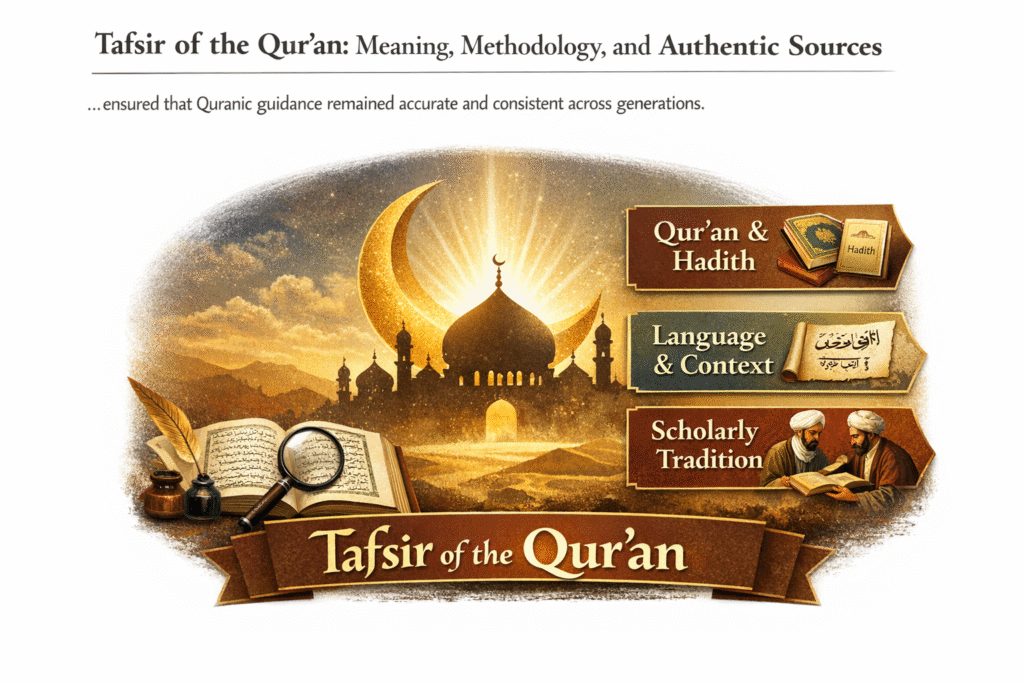
Islam strictly warns against interpreting the Qur’an based on personal opinion without knowledge. Tafsir must rely on:
- The Qur’an itself
- Authentic Hadith
- The understanding of early generations
- Arabic language and context
This protects the Qur’an from distortion and misinterpretation.
Tafsir bi-al-Ma’thur vs Tafsir bi-al-Ra’y
- Tafsir bi-al-Ma’thur: Interpretation based on the Qur’an, Hadith, and reports from the Sahabah and Tabi‘un
- Tafsir bi-al-Ra’y: Interpretation based on scholarly reasoning, used carefully within Islamic principles
Both are accepted when grounded in knowledge and authentic methodology.
In summary, Tafsir is not only allowed in Islam—it is a necessary discipline that ensures the Qur’an is understood correctly and responsibly.
3. What Is the Meaning of القرأن الكريم?
The term القرآن الكريم (Al-Qur’an Al-Kareem) refers to the final revelation sent by Allah to humanity. Each word in this title carries a deep and specific meaning.
Meaning of the Word Qur’an
The word Qur’an comes from the Arabic root qara’a, which means to recite or to be read aloud. This highlights the Qur’an’s nature as a recited revelation—meant to be read, memorized, reflected upon, and lived by. The Qur’an was revealed in clear Arabic and preserved through both recitation and writing.
Why the Qur’an Is Described as Al-Kareem
The Qur’an is described as Al-Kareem, meaning the Most Noble or the Most Generous. This title reflects:
- The nobility of its source (Allah)
- The honor of its message
- The generosity of its guidance and rewards
- The dignity it gives to those who follow it
Every interaction with the Qur’an brings benefit, whether through recitation, understanding, or practice.
The Qur’an as Revelation, Guidance, and Mercy
The Qur’an is divine revelation, not human speech. It serves as:
- Guidance for belief, worship, and daily life
- Mercy for those who seek truth and clarity
- A criterion between right and wrong
Through Tafsir, the Qur’an is understood not only as a sacred text but as a complete guide for spiritual, moral, and social life.
4. How Tafsir Is Done: The Science of Quranic Interpretation
Tafsir is not based on guesswork or personal reflection alone. It follows a well-established scholarly framework known as Usul al-Tafsir, which ensures that the Qur’an is explained accurately and responsibly.
Usul al-Tafsir (Principles of Interpretation)
Usul al-Tafsir refers to the foundational rules scholars follow when explaining the Qur’an. These principles determine which sources are used, how meanings are derived, and what limits must be observed to protect the Qur’an from misinterpretation.
The Qur’an Explaining the Qur’an
One of the strongest methods of Tafsir is explaining a verse using other verses of the Qur’an. Many passages clarify one another, making the Qur’an its own primary source of explanation.
Tafsir Through Authentic Hadith
The Sunnah of the Prophet ﷺ is a core source of Tafsir. The Prophet ﷺ explained verses directly and demonstrated their meanings through his actions. Authentic Hadith therefore play a crucial role in understanding how verses were revealed and applied.
Asbab al-Nuzul (Context of Revelation)
Asbab al-Nuzul explains the circumstances under which specific verses were revealed. Knowing this context helps prevent misunderstanding and clarifies whether a verse addresses a particular event or a general ruling.
Nasikh and Mansukh
Nasikh and Mansukh refers to verses that abrogate or modify earlier rulings. Understanding this principle is essential to avoid applying rulings incorrectly or out of context.
I‘rab al-Quran (Grammar and Structure)
I‘rab al-Quran focuses on Arabic grammar and sentence structure. Small grammatical details in Arabic can significantly affect meaning, making linguistic analysis a key part of Tafsir.
Balaghah and Qur’anic Eloquence
Balaghah examines the Qur’an’s eloquence, style, and rhetorical devices. This helps uncover deeper meanings, emphasis, and wisdom behind word choices and expressions.
Limits of Personal Opinion in Tafsir
Islam strictly limits interpreting the Qur’an based on personal opinion alone. Tafsir must be grounded in authentic sources, sound knowledge, and scholarly methodology. Personal reflection is encouraged, but it cannot replace disciplined Tafsir.
In summary, Tafsir is a structured science that combines revelation, language, context, and scholarship to preserve the true meaning of the Qur’an.
5. Famous Tafsir Books and Classical Scholars
Throughout Islamic history, scholars have produced Tafsir works that preserve the authentic understanding of the Qur’an. These classical Tafsir books remain essential references for students and scholars today.
Tafsir Ibn Kathir
Tafsir Ibn Kathir is one of the most widely read and trusted Tafsir works. Its methodology is primarily hadith-based, relying on:
- The Qur’an explaining the Qur’an
- Authentic Hadith
- Statements of the Sahabah and Tabi‘un
This approach makes it accessible while remaining firmly rooted in early Islamic scholarship.
Tafsir al-Tabari (Jami‘ al-Bayan)
Tafsir al-Tabari, also known as Jami‘ al-Bayan, is considered one of the foundational works of Tafsir. Imam al-Tabari systematically collected narrations from the early generations and evaluated them with scholarly precision. Many later Tafsir works are built upon his methodology.
Tafsir al-Qurtubi
Tafsir al-Qurtubi focuses strongly on Ahkam (legal rulings) derived from the Qur’an. It explains verses related to worship, ethics, and law, making it especially valuable for understanding how Qur’anic guidance is applied in daily life.
Tafsir al-Jalalayn
Tafsir al-Jalalayn, written by Imam Jalal al-Din al-Mahalli and completed by Imam Jalal al-Din al-Suyuti, is known for its concise and clear explanations. It is often recommended for readers seeking a brief yet reliable Tafsir.
Imam al-Suyuti and Imam al-Zarkashi
Imam al-Suyuti and Imam al-Zarkashi made major contributions to the sciences of the Qur’an (Ulum al-Qur’an). Their works laid the groundwork for understanding revelation, compilation, and interpretation—supporting Tafsir with strong methodological foundations.
These scholars and their works continue to shape how the Qur’an is studied and understood across the Muslim world.
6. Is Tafsir Ibn Kathir Sunni or Shia?
Tafsir Ibn Kathir is widely recognized as a Sunni Tafsir, and understanding why requires looking at its author and methodology.
Background of Imam Ibn Kathir
Imam Ismail ibn Umar Ibn Kathir (1301–1373 CE) was a renowned Islamic scholar from Damascus. He specialized in Tafsir, Hadith, history, and jurisprudence, dedicating his life to preserving authentic knowledge of the Qur’an and Sunnah.
His Creed and Scholarly Methodology
Ibn Kathir followed the Sunni tradition, adhering to the creed of Ahl al-Sunnah. His Tafsir emphasizes:
- Hadith-based explanations
- Opinions of the Sahabah and Tabi‘un
- Evidence from classical scholarship rather than personal speculation
This rigorous methodology ensures that his interpretations remain aligned with Sunni orthodoxy.
Why Tafsir Ibn Kathir Is Recognized as Sunni
Because of Ibn Kathir’s adherence to Sunni principles, his Tafsir reflects the Sunni understanding of Aqeedah, jurisprudence, and Qur’anic interpretation. While respected by all Muslims for its accuracy, it is particularly grounded in the Sunni scholarly tradition.
7. Tafsir of the Quran in Different Forms
Tafsir is available in different forms, each helping readers understand the Qur’an more effectively depending on their level and language.
Tafsir of the Quran (General Approach)
A general or verse-by-verse Tafsir explains each Ayah in detail. This method covers:
- Linguistic dimensions: word meanings, grammar, and structure
- Legal dimensions: rulings derived from verses (Ahkam)
- Spiritual dimensions: guidance for belief, morality, and character
Verse-by-verse Tafsir is ideal for learners seeking comprehensive understanding of the Qur’an.
Tafsir in Arabic
Arabic Tafsir is the most authentic way to study the Qur’an because it preserves the original language and nuances. Benefits include:
- Understanding subtle linguistic details
- Accessing classical Tafsir works directly
- Deepening comprehension of Qur’anic eloquence (Balaghah)
Studying Tafsir in Arabic is recommended for advanced learners and scholars.
Tafsir in English
For non-Arabic speakers, English Tafsir makes the Qur’an accessible while maintaining accuracy. Good English Tafsir resources:
- Explain word meanings and context
- Summarize classical interpretations
- Provide practical guidance for everyday life
English Tafsir is perfect for beginners or learners outside the Arab world.
Choosing the Right Tafsir
- Start with concise or English Tafsir if you are a beginner.
- Move to classical Arabic Tafsir for deeper study.
- Always rely on authentic scholarly sources to ensure correct understanding.
Tafsir in any form connects recitation with understanding, helping the Qur’an guide thought, action, and spirituality.
8. Tafsir Online: Learning in the Digital Age
With the growth of the internet, Tafsir learning has become more accessible than ever. Online platforms provide opportunities for students around the world to study the Qur’an with guidance from qualified scholars.
Growth of Online Tafsir Resources
Many websites, apps, and video courses now offer Tafsir explanations in multiple languages, making it easier for beginners and advanced learners alike to access authentic content anytime, anywhere.
Benefits of Accessibility and Flexibility
Online Tafsir allows learners to:
- Study at their own pace
- Revisit lessons multiple times
- Choose formats that suit their learning style, such as video, audio, or text
This flexibility makes it easier to integrate Tafsir study into daily life.
Importance of Authentic, Scholar-Led Platforms
Not all online content is reliable. It is crucial to choose scholar-led Tafsir platforms that reference authentic sources, classical scholarship, and the Sunnah of the Prophet ﷺ. This ensures accurate understanding and prevents misinterpretation.
Caution Against Unsourced Interpretations
Learners should avoid Tafsir from unknown sources or social media posts without verification. Misunderstanding a verse can lead to confusion or misapplication. Always rely on verified scholars and trusted platforms.
Studying Tafsir online can be highly effective when combined with structured learning, teacher guidance, and authentic references—making the Qur’an’s guidance accessible to everyone.
9. Learning Tafsir the Right Way
Studying Tafsir effectively requires guidance, structure, and patience. It is not just reading or memorizing; it involves understanding the Qur’an deeply and accurately.
Why Tafsir Should Be Learned with Guidance
Tafsir should always be learned under qualified scholars or teachers. Their expertise ensures that interpretations are correct, authentic, and aligned with classical scholarship.
Understanding Context, Language, and Scholarly Differences
A verse can have multiple layers of meaning. Learning Tafsir properly involves:
- Grasping the context of revelation (Asbab al-Nuzul)
- Understanding Arabic language and grammar
- Recognizing scholarly differences in interpretation
This helps prevent misunderstanding or misapplying verses.
Avoiding Misinterpretation Through Structured Study
Random or self-taught Tafsir study can lead to errors. A structured approach ensures that students learn gradually, building knowledge step by step while staying grounded in authentic sources.
Gradual Learning for Depth and Clarity
Tafsir is best learned slowly and consistently. Each lesson builds upon the previous one, helping learners gain clarity, confidence, and a deeper spiritual connection to the Qur’an.
Practical Application
Al Huda Network offers structured Tafsir and Qur’an learning programs for children and adults. Students receive step-by-step guidance from qualified teachers, combining reflection, discussion, and practice. Over time, this approach develops sound understanding, confidence, and a meaningful connection with the Qur’an, making Tafsir an enriching part of daily life
10. Tafsir in the Modern World
Tafsir continues to evolve to meet the needs of modern learners, offering tools to understand the Qur’an in today’s context without compromising authenticity.
Thematic Tafsir of the Quran
Thematic Tafsir organizes verses around specific topics, such as morality, law, or social issues. This approach helps readers apply Quranic guidance directly to modern life.
Addressing Contemporary Issues Through Tafsir
Modern Tafsir addresses current challenges like ethical dilemmas, social justice, and family life. Scholars explain how timeless Qur’anic principles remain relevant and applicable today.
Scholarly Perspectives on Scientific Tafsir
Some Tafsir explores the relationship between the Qur’an and natural phenomena, known as scientific Tafsir. While scholars caution against overinterpretation, these insights can enhance appreciation of the Qur’an’s wisdom when used responsibly.
Fi Zilal al-Quran: A Reflective Modern Tafsir
Fi Zilal al-Quran (In the Shade of the Qur’an) is a modern Tafsir that combines spiritual reflection, linguistic insight, and contextual commentary. It demonstrates how classical methods can be adapted to contemporary understanding while remaining faithful to authentic sources.
Conclusion: Tafsir as a Lifelong Journey with the Quran
Tafsir is more than academic study—it is a bridge between Quranic revelation and practical guidance. By understanding the Qur’an through Tafsir, readers can apply its teachings in daily life with clarity and confidence.
Humility and authenticity are essential. Approaching Tafsir requires recognizing the limits of personal understanding and relying on qualified scholars, authentic sources, and classical methodology. This ensures that the Qur’an is interpreted correctly and meaningfully.
Engaging with Tafsir is a lifelong journey. Every verse studied deepens knowledge, strengthens faith, and nurtures a closer connection with Allah. Structured programs, like those offered by Al Huda Network, provide learners of all ages with step-by-step guidance, helping make Tafsir an enriching and transformative part of life.